






















By Graham Bruford, Global Knowledge Manager at the Better Cotton Initiative (BCI)

Collaboration, knowledge sharing, and exciting innovations: those were at the heart of the Better Cotton Initiative’s tenth annual Programme Partner Meeting (PPM), held online over four days in January and February. The event brought together our Programme Partners, who support BCI farmers to improve practices in line with the BCI Standard. They heard thought-provoking presentations from two keynote speakers and held in-depth discussions on key implementation topics, led by partners and colleagues.
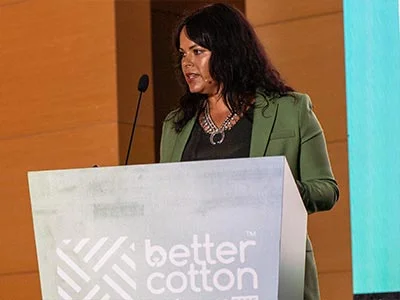
The busy agenda was kicked off by our CEO Nick Weatherill, who emphasised the centrality of partnership to BCI’s success to date. Nick highlighted that BCI and the cotton sector’s future success will depend on four interlinked imperatives: impact, integrity, influence, and investment. Partnership, he stressed, is a critical supporting element, enabling alignment, collaboration, and long-term progress.
“I’m a passionate believer in partnership”, Nick said. “There’s no doubt that, in the collective search for solutions, we are together much greater than the sum of our individual parts.”
Partners received key updates on the implementation and results of certification audits held over the past season, which demonstrated the commitment of our partners in successfully adapting to the revised procedures. They also heard about BCI’s approach to regenerative agriculture, a key component of the upcoming version 3.2 of our Principles & Criteria, which underpins BCI’s transition towards becoming a regenerative standard system.

Adaptive leadership in a complex farming landscape
In his keynote, humanitarian and author Ben Ramalingam spoke on ‘Navigating Complexity in Sustainable Cotton through Adaptive Leadership’. He reminded us that “cotton is more than just a fabric; it’s the living thread that weaves us together.” Drawing on case studies from around the world, Ben explored the complexity of cotton farming systems, using this to share his five key principles for adaptive leadership:
- Evidence-based learning and adaptation – seeing the whole picture and learning from data;
- Scenario-based stress testing – preparing for change and uncertainty ahead;
- Deliberative decision-making – thinking decisions through before you act;
- Transparency, inclusion, accountability – being inclusive in your dialogue;
- Collective action – learning together and acting together when you can’t solve things on your own.
Ben’s presentation provided an important opportunity for everyone to reflect on how we can work together through the adaptive leadership principles to facilitate improved farmer livelihoods.
A collective call to action for Decent Work
Javed Hussain, Executive Director of the Sindh Community Foundation, gave a passionate and uplifting presentation focusing on key achievements in the foundation’s work advocating for women’s rights in Pakistan over the past decade. He explored how the organisation had secured social protections, health and safety rights and increased wages for women farmers and workers, and stressed the importance of collective action, freedom of association, literacy, and education in achieving this. He called on BCI and its partners to:
- Invest in collectives, supporting worker-led collectives and trade unions as core infrastructure;
- Prioritise worker voices, treating the worker voice as an essential Decent Work indicator;
- Support education on workers’ rights, providing dedicated funding;
- Address heat stress, treating it as a labour rights priority, not just a safety issue;
- Commit to long-term organising and systems change, not short-term projects.
His message underscored the need to take meaningful action on the ground rather than treating Decent Work as an optional add‑on.
Showcasing partner‑led innovation
Following the keynotes, we held a series of interactive breakout sessions in which Programme Partners shared details of their experiences on cross-cutting impact themes and Decent Work topics. It was heartening to see the way in which partners proactively engaged in these sessions, both sharing their own experiences and learning from others.
We also showcased field-level innovations through a series of short partner‑produced videos, highlighting the creativity and commitment of teams working to support farmers in adopting improved practices.
Our Programme Partners remain essential to BCI’s ongoing success, providing the critical link with cotton farmers. Their commitment to sharing their innovations and knowledge and their enthusiasm to delivering real change on the ground are truly inspiring. We’d like to thank everyone who attended for sharing their learnings and expertise.
We now look forward to next year’s Programme Partner meeting, which will take place alongside the BCI Conference. This will be an important opportunity for Programme Partners to strengthen their connections and dialogue with all the stakeholders in the cotton sector: brands, retailers, manufacturers, suppliers, governments and farmers. We will share more information on this soon – stay tuned!